

Using 3D markerless pose estimation programs to determine fear reactivity in human infants.
Samantha Finkbeiner, 5th year; William Quackenbush, 5th year; Charlotte Best, 1st year
Abstract
Infancy is a key period in the development of fear, an essential emotion involving recognizing and responding to threatening stimuli. Researchers studying infant fear rely on parental reports and direct assessment of child behavior either in the home or structured laboratory settings. The objective of our study is to develop automated approaches for direct assessment of infant behavior.
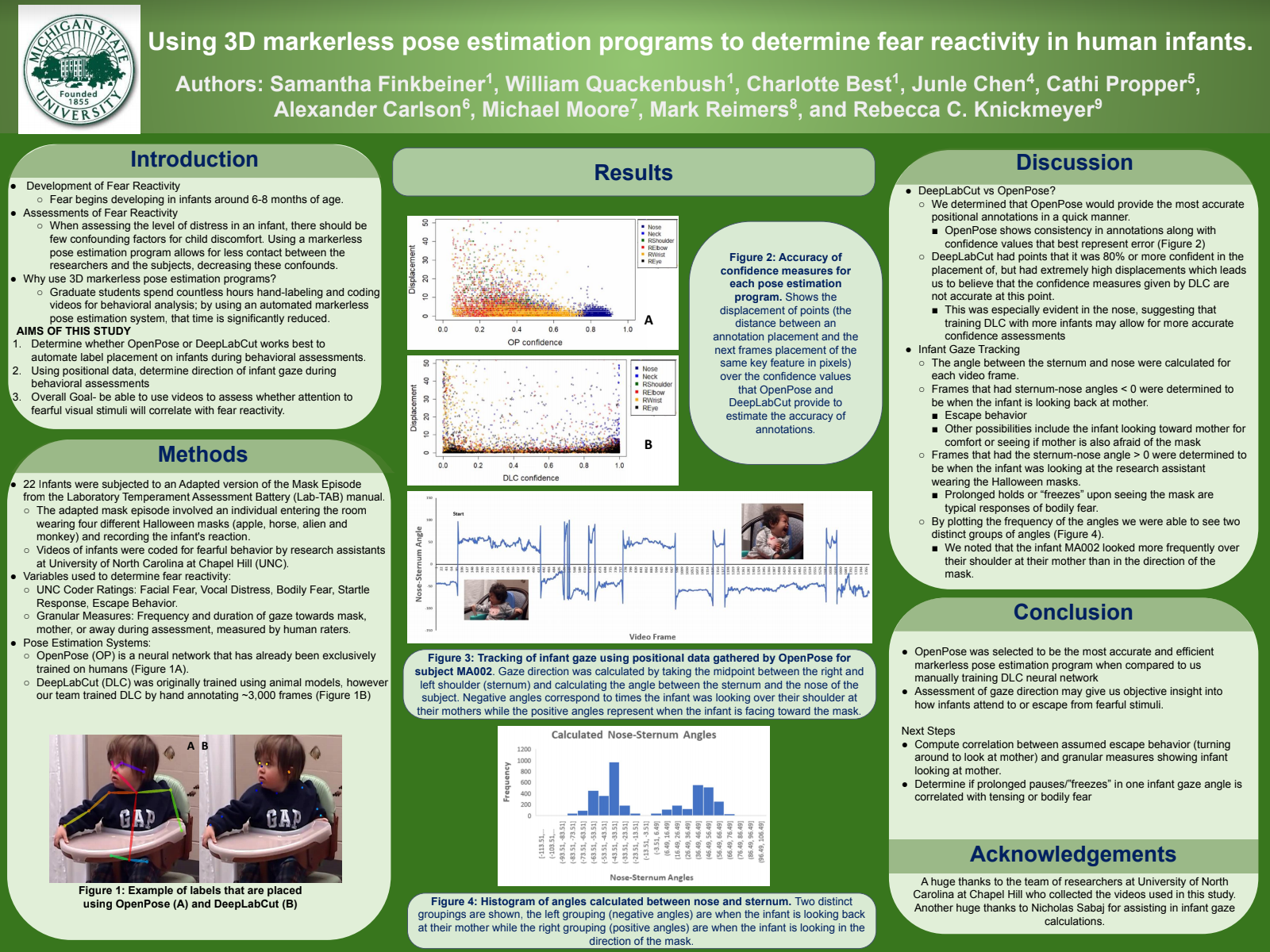
Specifically, we are testing if a markerless pose estimation program can effectively track infants’ reactions during a paradigm adapted from the Laboratory Temperament Assessment Battery (Lab-TAB) Mask episode. DeepLabCut and OpenPose are 3D markerless pose estimation programs based on transfer learning with deep neural networks. DeepLabCut was designed for a single animal, while OpenPose was trained to work on multiple human subjects. Both allow users to track key features on the body as they move through space. Our goal is to determine which program will give the most accurate motion tracking for our project. Videos were collected by a research team at the University of North Carolina at Chapel Hill. Poisson regression was used to determine whether body part movement during mask presentation predicts an expert rater’s assessment of whether specific fear behaviors are present. Preliminary results suggest movement of the eyes and nose predict both the presence of bodily fear and startle responses with McFadden’s R-Squared between 0.2 and 0.4. Ultimately, we hope to develop user-friendly methods of assessing highly complex infant behaviors, which could be deployed to a wide range of research labs.
Click to open in new tab.