
2021 MSUFCU Runner up History, Philosophy, and Sociology of Science presentation for the Lyman Briggs Research Showcase
 |
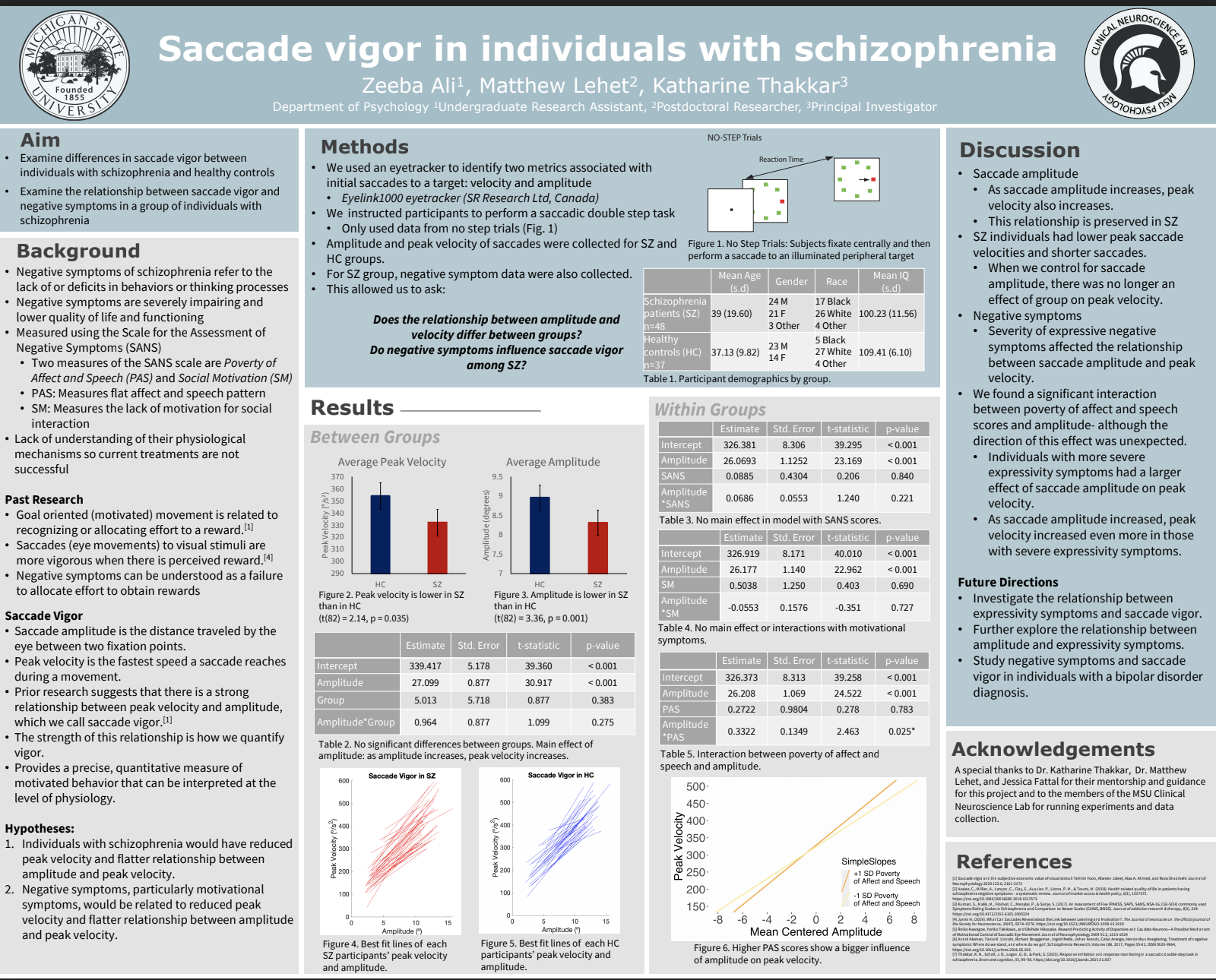
Saccade Vigor in Individuals with Schizophrenia
Zeeba Ali , 2nd-year |
Abstract:
Schizophrenia is a debilitating psychiatric disorder that is associated with huge personal and societal costs. Along with hallucinations and delusions, individuals with schizophrenia often experience profound amotivation and anhedonia—the inability to seek out activities and to derive pleasure. These so-called negative symptoms are gravely impairing and are more predictive of meaningful functional outcome measures, like employment and relationships, than the florid psychosis that is more commonly associated with schizophrenia.
The mechanisms underlying motivational symptoms are unknown, impeding treatment development. One promising notion is that the motivational and hedonic symptoms of schizophrenia reflect a failure in allocating effort to obtain rewards. A novel angle for studying reward processing is to look at basic movement. We walk more quickly to the people we love: we move more vigorously the more we want something. Thus, motivational symptoms of schizophrenia may leave their traces even in simple movement kinematics that can be precisely quantified. As a further advantage, a rich body of human and non-human animal work has described the neural correlates of movement vigor. Physiology data from non-human primates suggests that saccadic eye movements (rapid shifts of gaze) made to more rewarding stimuli are more vigorous and are associated with more dopaminergic activity—a neuromodulator associated with reward. Thus, measuring saccade vigor provides a precise, quantitative measure of motivated behavior that can be interpreted at the level of physiology and is relatively immune to confounds related to general cognitive functioning. We hypothesize reduced saccade vigor in patients with schizophrenia, particularly those with severe negative symptoms. To investigate this idea, we will calculate saccade vigor across multiple datasets from individuals with schizophrenia and healthy controls performing tasks where subjects made rapid saccades to visual stimuli. We will compare saccade vigor across groups and relate measures of saccade vigor to negative symptom severity. These findings may provide insights into mechanisms of motivational symptoms in schizophrenia.