
The Presence of Escherichia Coli in Stagnant vs Flowing Water Sources
 |
Aidan Gard, 2nd year |
 |
Nandini Koneru, 2nd year |
 |
Vira Mehta, 2nd year |
 |
Emma Topacio, 2nd year |
Abstract
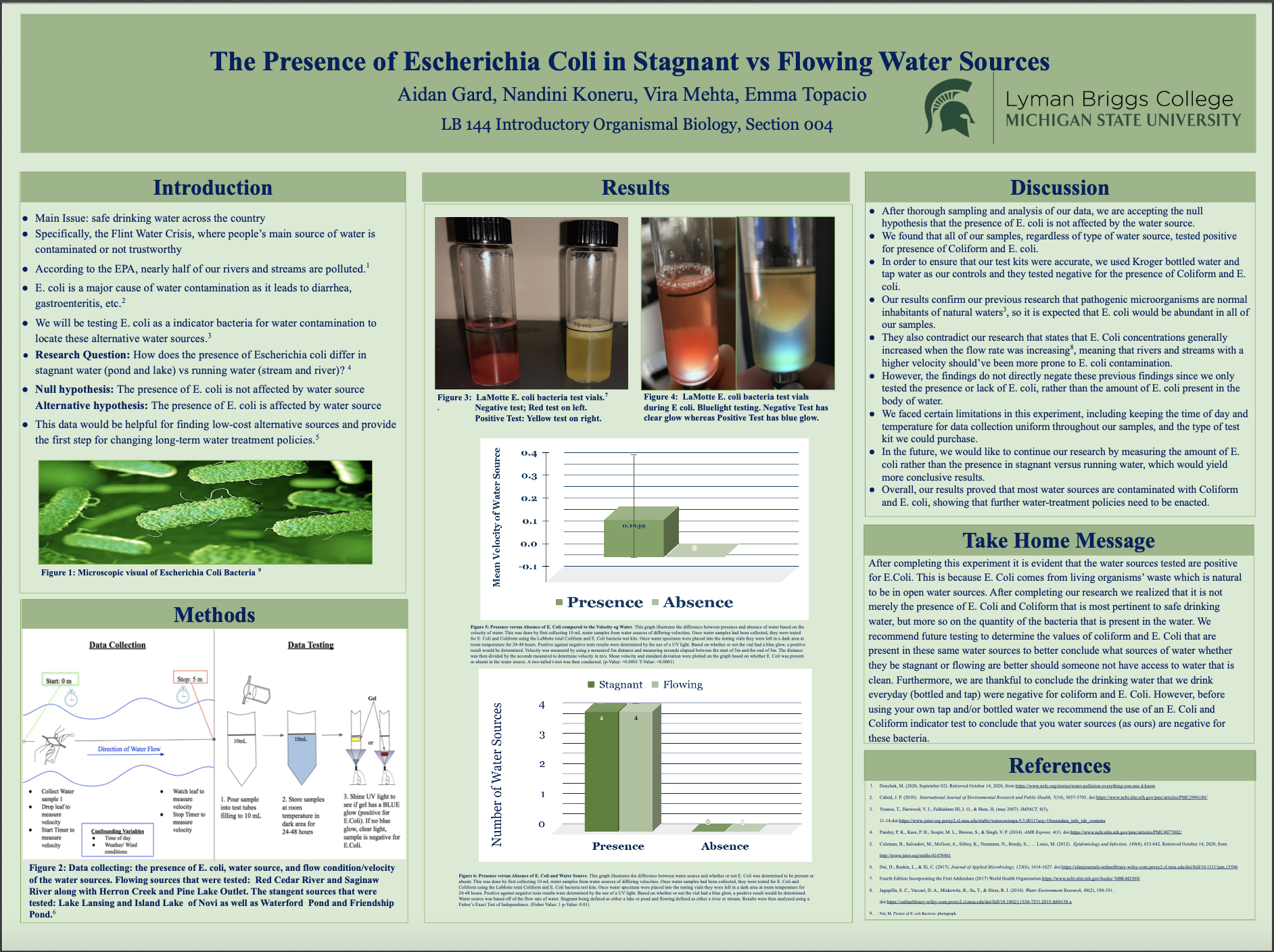
In this project we set out to investigate the presence of Esceheria Coli in Stagnant versus running water. After noticing how prevalent issues with water quality and safety are across the country and world, obtaining safe drinkable water was an issue we wanted to look into. The ongoing Flint Water Crisis was our prime example in which the citizens’ main source of water was contaminated with lead and deemed unsafe. We used two types of water sources: stagnant water sources and flowing water sources.
We calculated the velocity of the water flow in order to distinguish between stagnant and flowing water sources. We then used testing kits to determine the presence or absence of E. Coli in the water. After analysis, we are accepting the null hypothesis that the presence of E. coli is not affected by the water source. We found that all of our samples, regardless of the type of water source, tested positive for presence of Coliform and E. coli. Our results confirm our previous research that pathogenic microorganisms are normal inhabitants of natural waters, so it is expected that E. coli would be abundant in all of our samples. In the future, we would like to continue our research by measuring the amount of E. coli rather than the presence in stagnant versus running water, which would yield more conclusive results. Overall, our results proved that most water sources are contaminated with Coliform and E. coli, showing that further water-treatment policies need to be enacted.