

 |
Conscientious Mammalian Magnetoreception Capabilities by Means of the Cryptochrome-2 Protein Megan Weil, 2nd year |
Abstract
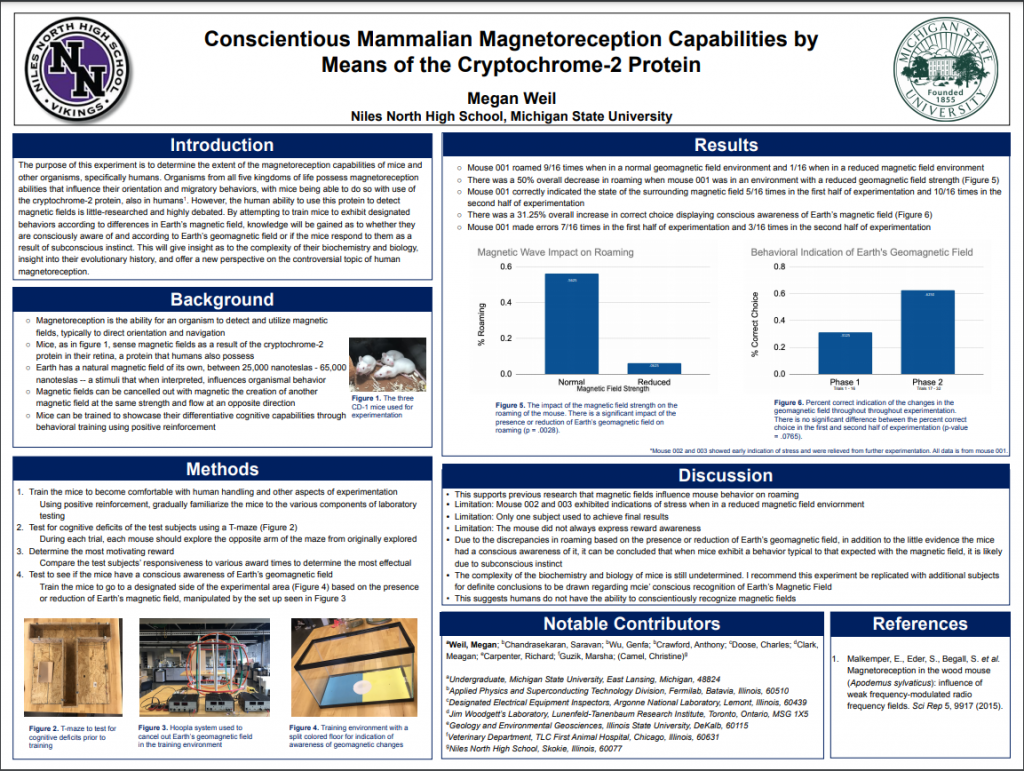
Changes in Earth’s magnetic field are known to influence the behavior of organisms from all five kingdoms of life. In mice, the cryptochrome-2 repressor is the recognized protein responsible for their magnetoreception capabilities. The extent of the receptor’s influence is unknown, and whether its associated responses are due to subconscious instinct or conscious choice.
We tested if the mice learn to immediately run to the corresponding area they were trained based on the presence or reduction of Earth’s magnetic field, that they possess a conscious recognition of Earth’s geomagnetic field. To test for this, we trained three CD-1 mice to run to a designated side of an experimental area given the state of their exposure to Earth’s magnetic field, normal or weakened. The results of the study supported strong evidence that magnetic field influences mice impact on roaming (p = .0028), with a reduced magnetic field decreasing the amount of time the mouse roamed. Additionally, these findings support with little evidence that mice can consciously detect Earth’s geomagnetic field (p = .0765). This suggests that the cryptochrome-2 protein may be less complex than initially understood and that magnetic field recognition is not impacting mouse behavior and location preferences. This is crucial for understanding the extent of the capabilities of the cryptochrome-2 protein, applicable to the influence of Earth’s geomagnetic field on humans. As humans also possess the protein, such research is especially useful for understanding the arising field regarding the impacts of magnetic field exposure on human health.
Click to open in a new tab.