

 |
Identifying Mechanisms of Phage Defense in Vibrio cholerae Using High-Throughput Barcode Sequencing Drew Beckman, 2nd year |
Abstract
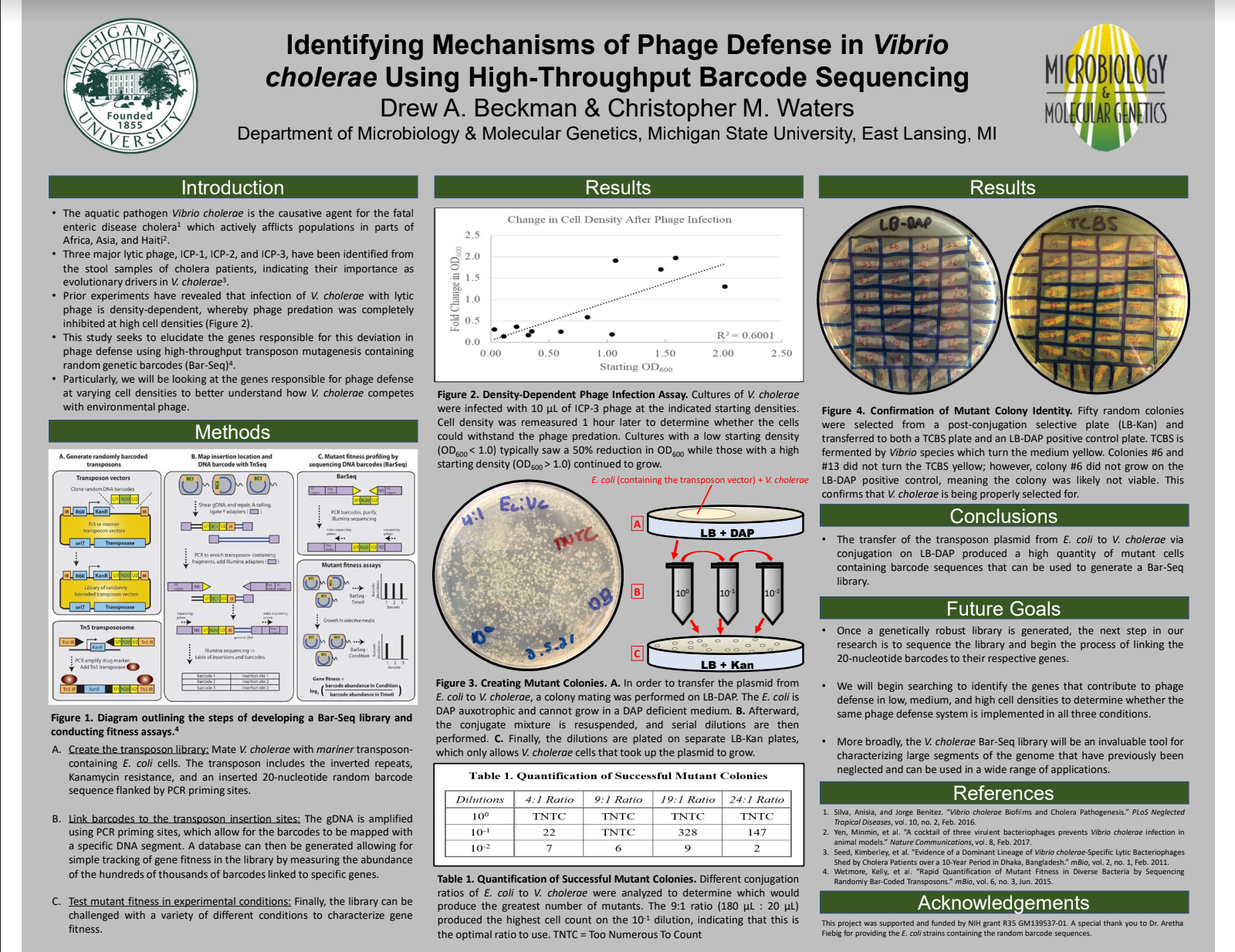
Phage, viral parasites of bacteria, are primary drivers of bacterial evolution and ecology. My research centers on understanding how the bacterial pathogen Vibrio cholerae, the causative agent of the diarrheal disease cholera, defends itself against phage infection. Prior research revealed that the ability of lytic phage to infect V. cholerae was density-dependent such that phage infection did not occur at high cell densities.
To characterize which genes are responsible for this shift in phage defense, I plan to employ a systems biology approach that utilizes transposon mutagenesis with random genetic barcodes (Bar-Seq). For this approach, hundreds of thousands of V. cholerae transposon mutants, each identified by 20 base pair unique barcode sequences, will be constructed, creating a system that tracks relative mutant abundance under selective conditions. The mutant library will then be challenged at high cell densities with ICP-1, ICP-2, and ICP-3, the three common lytic phage of V. cholerae. The fitness of each gene will be analyzed by comparing the number of hits for each barcode, representing unique transposon mutations, before and after phage infection. Mutants that exhibit decreased abundance post-infection demonstrate decreased fitness and possibly contribute to the ability of V. cholerae to resist phage infection at high cell densities. Once established, this barcode sequencing approach can be utilized to study phage infection of V. cholerae in dozens of different environments. Future research will more closely examine the function of genes identified by Bar-Seq to further elucidate their role in high cell density resistance to ICP phage infection.
Click to open in new tab.