

 |
The Role of the Aryl Hydrocarbon Receptor Polymorphisms in Modulating 2,3,7,8-tetrachlorodibenzo-p-dioxin (TCDD)-induced HMGCR expression Zach D’Haem, 2nd year |
Abstract
Hypercholesterolemia, obesity, and non-alcoholic fatty liver disease (NAFLD) have increased in the US population to epidemic proportions. NAFLD increases the risk for cardiovascular disease, type II diabetes, and hepatocellular carcinoma. Epidemiological and rodent studies have linked NAFLD progression and cholesterol dysregulation with exposure to environmental pollutants such as 2,3,7,8-tetrachlorodibenzo-p-dioxin (TCDD). TCDD is the most potent ligand for the aryl hydrocarbon receptor (AHR).
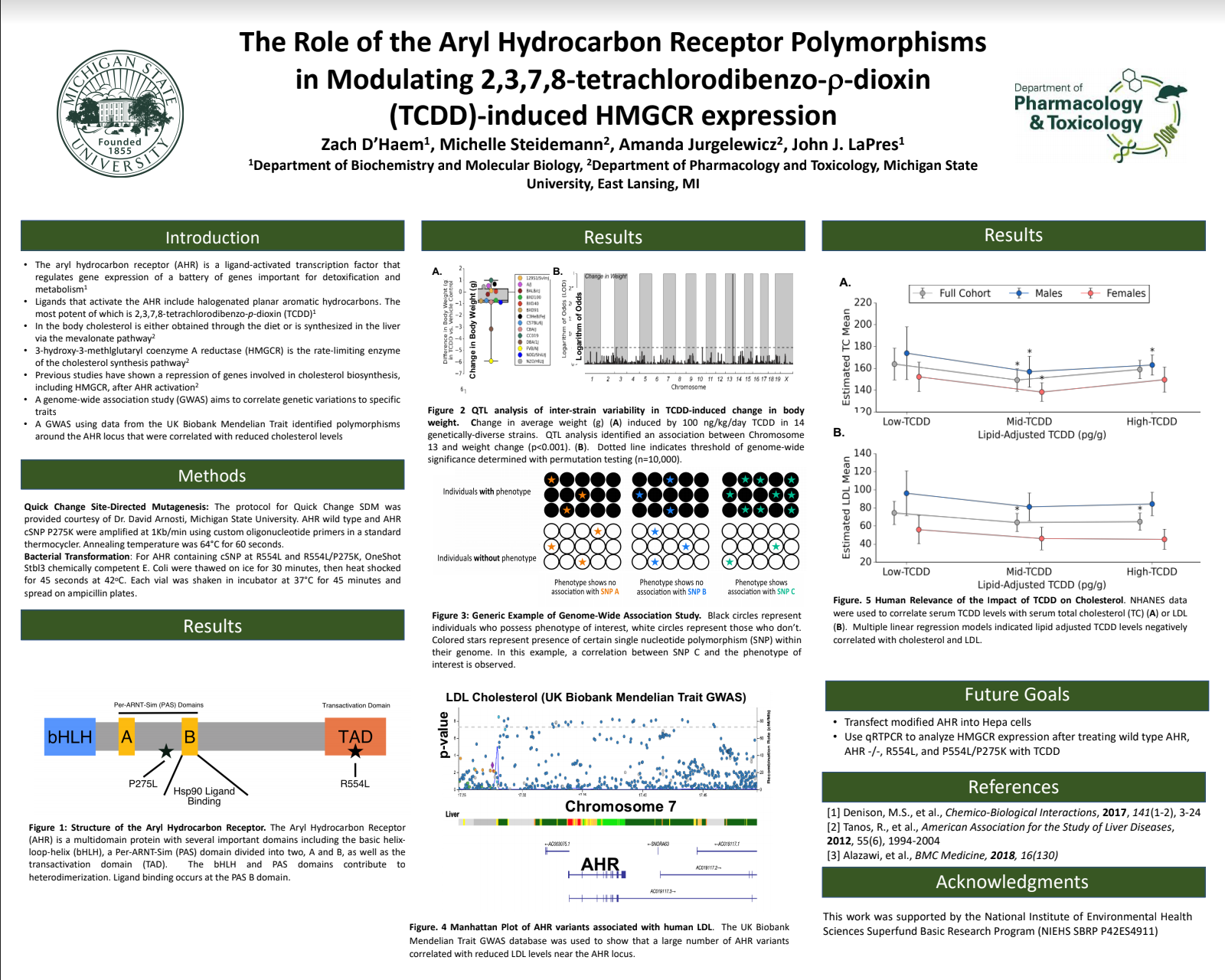
The AHR is a ligand-activated transcription factor that regulates many genes including 3-hydroxy-3-methlglutaryl coenzyme A reductase (HMGCR), which encodes the rate-limiting enzyme of cholesterol synthesis. Data from genome-wide association studies (GWAS) and the National Health and Nutrition Examination Survey (NHANES) suggest there is a relationship between the AHR and cholesterol levels. Using a panel of 14 strains of mice, it was shown that a locus within 0.5 Mb of HMGCR was associated with TCDD-induced weight change. This result was similar to observations in a human GWAS where polymorphisms around the AHR locus were correlated with reduced cholesterol levels. Importantly, this GWAS identified two coding single nucleotide polymorphisms (cSNPS) within the AHR (R554L and P275L) that are significantly correlated with changes in human cholesterol homeostasis. The goal of this project is to test the hypothesis that these two cSNPs impact AHR-mediated HMGCR expression. To address this goal these mutations will be introduced into an AHR expression plasmid and then inserted into AHR null cells. These cell strains will be exposed to TCDD and HMGCR expression will be assessed by quantitative real time polymerase chain reaction.
Click to open in new tab.