

Examining the Influence of Different Microbiota Compositions on Male Mouse Bone Density and Architecture using Microcomputed Tomography
 |
Soumya Chennupati, 2nd year |
 |
Sandra O’Reilly, Ph.D. |
 |
Ho Jun Kang, Graduate Student |
 |
Narayanan Parameswaran, BVSc., Ph.D. |
 |
Laura McCabe, Ph.D. |
Abstract
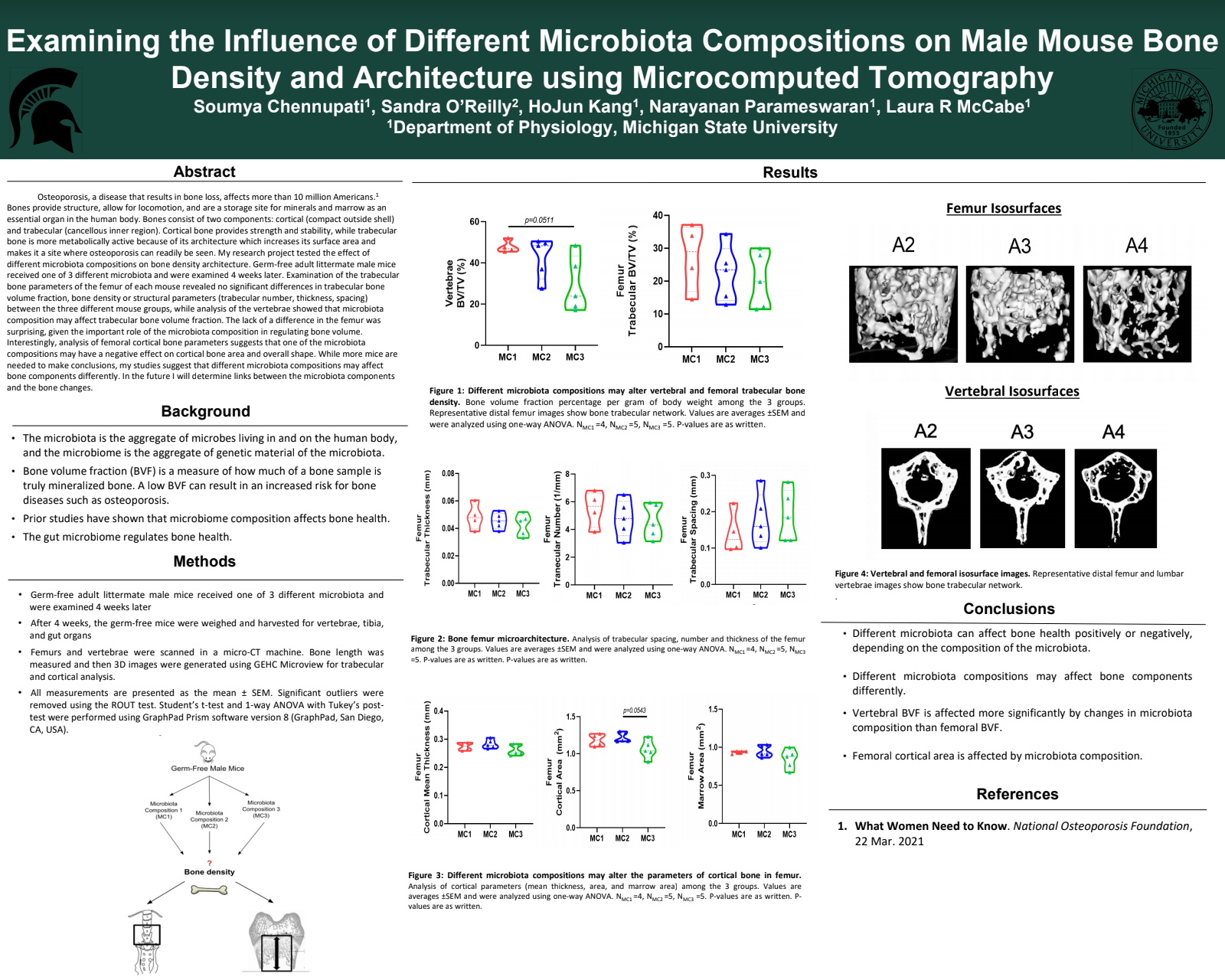
Osteoporosis, a disease that results in bone loss, affects more than 10 million Americans.1 Bones provide structure, allow for locomotion, and are a storage site for minerals and marrow as an essential organ in the human body. Bones consist of two components: cortical (compact outside shell) and trabecular (cancellous inner region).
Cortical bone provides strength and stability, while trabecular bone is more metabolically active because of its architecture which increases its surface area and makes it a site where osteoporosis can readily be seen. My research project tested the effect of different microbiota compositions on bone density architecture. Germ-free adult littermate male mice received one of 3 different microbiota and were examined 4 weeks later. Examination of the trabecular bone parameters of the femur of each mouse revealed no significant differences in trabecular bone volume fraction, bone density or structural parameters (trabecular number, thickness, spacing) between the three different mouse groups, while analysis of the vertebrae showed that microbiota composition may affect trabecular bone volume fraction. The lack of a difference in the femur was surprising, given the important role of the microbiota composition in regulating bone volume. Interestingly, analysis of femoral cortical bone parameters suggests that one of the microbiota compositions may have a negative effect on cortical bone area and overall shape. While more mice are needed to make conclusions, my studies suggest that different microbiota compositions may affect bone components differently. In the future I will determine links between the microbiota components and the bone changes.
Click to open in new tab.