
Genome-wide associations for coat color traits in a cross of domestic pig breeds
Roshan Patel, 4th year
Abstract
Exploitation of genetic variation through selection is important because it allows desirable alleles to be passed down to future generations, resulting in improved phenotypes. Thus, knowing how genetic variations affect phenotypic traits is beneficial for breeding because it enables artificial selection to be implemented more effectively to improve the performance of livestock populations.
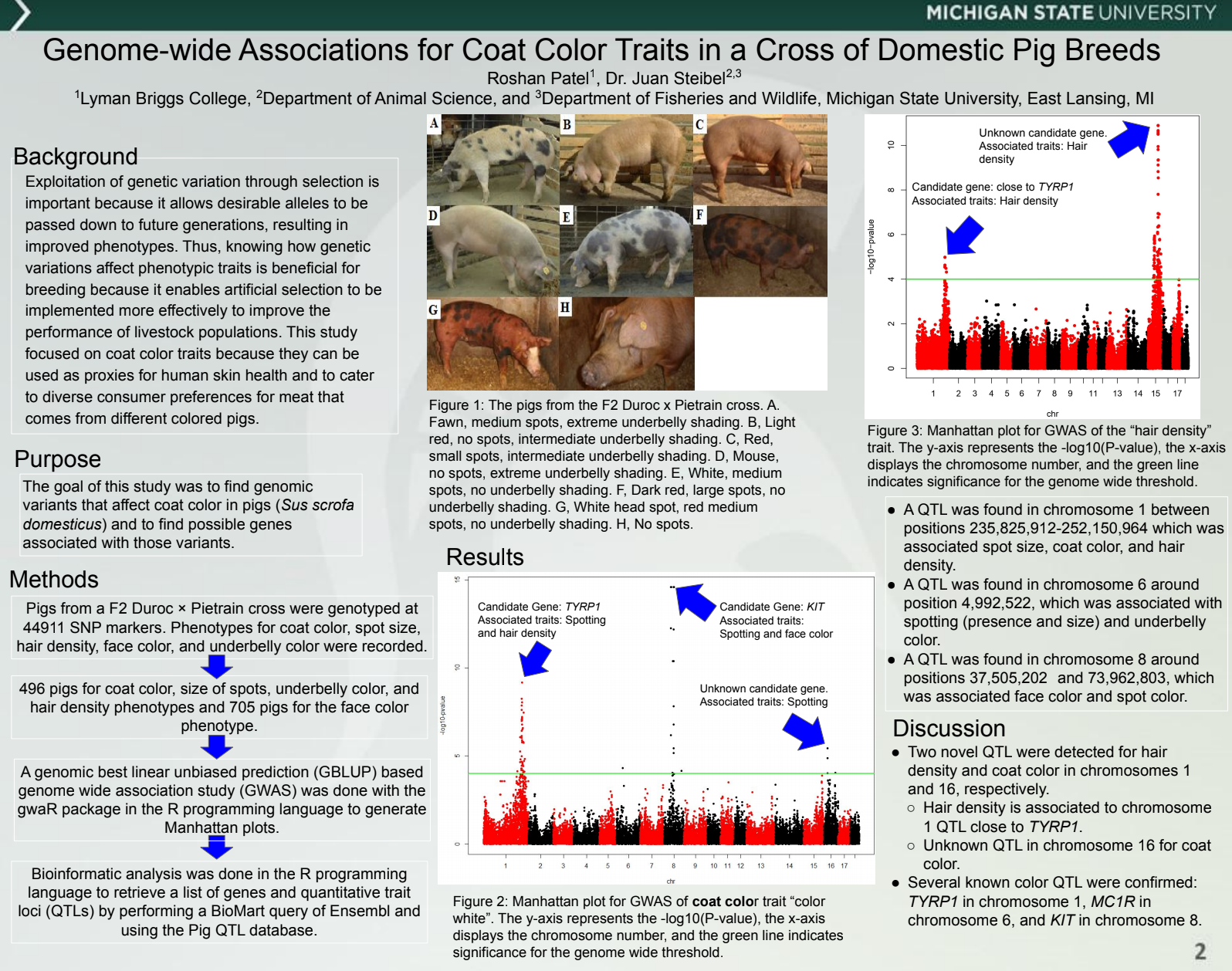
The goal of this study was to find genomic variants that affect coat color in pigs. The study used a dataset from a F2 cross of two pig breeds generated at Michigan State University. The dataset had a sample size of 496 pigs for coat color, size of spots, underbelly color, and hair density traits phenotypes and 705 pigs for face color phenotype. The pigs were genotyped at 44911 SNP markers. The statistical analysis used linear mixed models including effects of DNA markers as well as random effects of animals to account for relationships between pigs. Biological interpretation of statistically significantly QTL regions was done by querying Ensembl BioMart (http://useast.ensembl.org/biomart/martview/) and animal QTL databases (https://www.animalgenome.org/cgi-bin/QTLdb/SS/search). A total of 11 significant QTLs were found for 5 color traits. Putative QTLs were located in chromosomes 1, 2, 6, 8, 15, and 16. Some of these QTL regions spanned known genes for affecting coat color such as MC1R, KIT, and TYRP1. Moreover, two of these QTLs are novel QTLs. All in all, we mapped genetic variants that affect the coat color of pigs that can be used for selection schemes in the purebred and crossbred pig industry.