

Structural and Sequence Conservation of the CtBP Corepressor C-Terminal Domain Across Vertebrate Species
 |
Kalynn Bird, 3rd year |
 |
Madeline Niblock, 3rd year |
Abstract
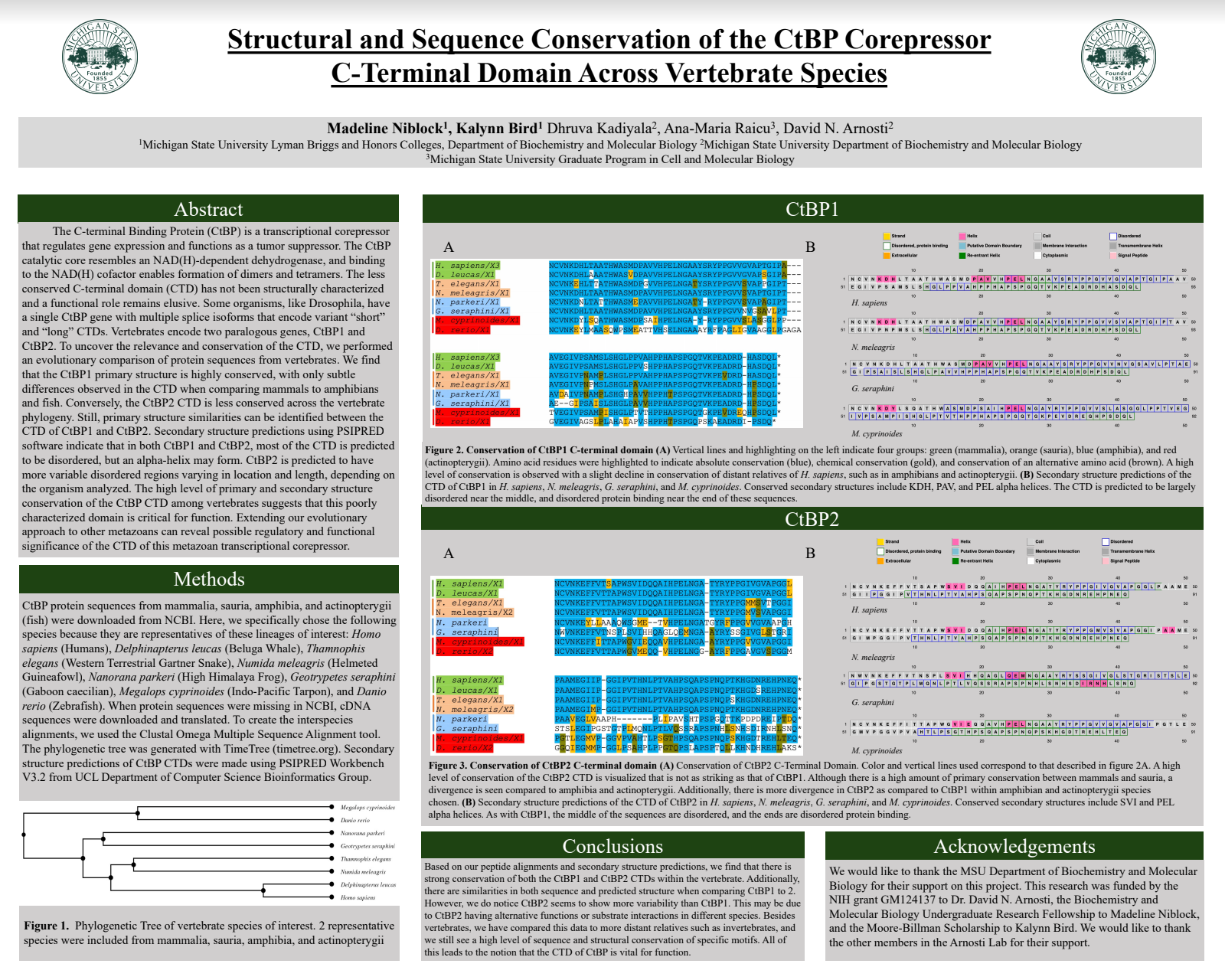
The C-terminal Binding Protein (CtBP) is a transcriptional corepressor that regulates gene expression and functions as a tumor suppressor. The CtBP catalytic core resembles an NAD(H)-dependent dehydrogenase, and binding to the NAD(H) cofactor enables formation of dimers and tetramers. The less conserved C-terminal domain (CTD) has not been structurally characterized and a functional role remains elusive. Some organisms, like Drosophila, have a single CtBP gene with multiple splice isoforms that encode variant “short” and “long” CTDs. Vertebrates encode two paralogous genes, CtBP1 and CtBP2.
To uncover the relevance and conservation of the CTD, we performed an evolutionary comparison of protein sequences from vertebrates. We find that the CtBP1 primary structure is highly conserved, with only subtle differences observed in the CTD when comparing mammals to amphibians and fish. Conversely, the CtBP2 CTD is less conserved across the vertebrate phylogeny. Still, primary structure similarities can be identified between the CTD of CtBP1 and CtBP2. Secondary structure predictions using PSIPRED software indicate that in both CtBP1 and CtBP2, most of the CTD is predicted to be disordered, but an alpha-helix may form. CtBP2 is predicted to have more variable disordered regions varying in location and length, depending on the organism analyzed. The high level of primary and secondary structure conservation of the CtBP CTD among vertebrates suggests that this poorly characterized domain is critical for function. Extending our evolutionary approach to other metazoans can reveal possible regulatory and functional significance of the CTD of this metazoan transcriptional corepressor.
Click to open in new tab.