

Directed Spatial Structure and Patterning in Synthetic Communities
 |
Daniel Ducat, Principal Investigator |
 |
Lisa Yun, Ph.D. Candidate |
 |
Kimberly Watson, 4th year |
Abstract
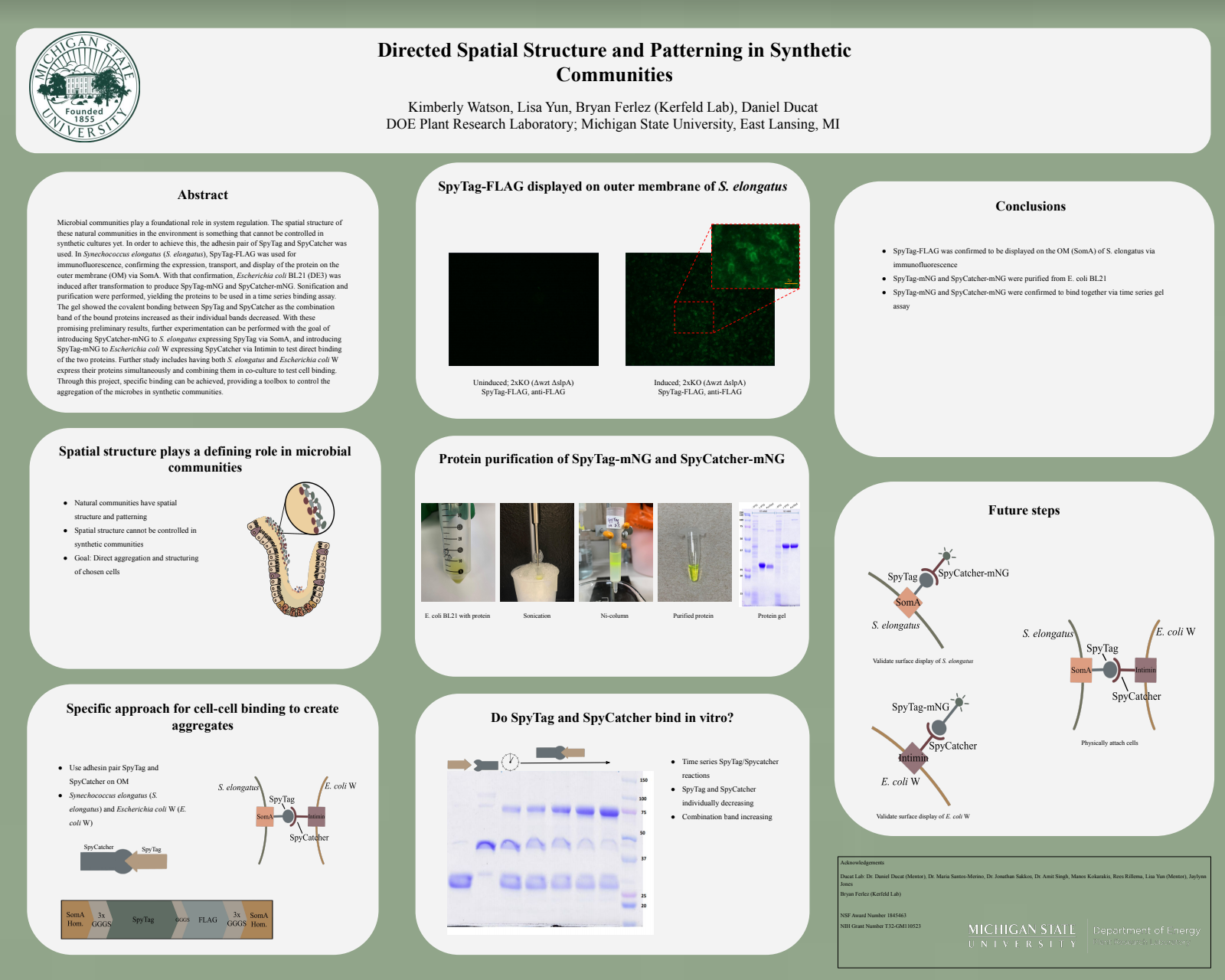
Microbial communities play a foundational role in system regulation. The spatial structure of these natural communities in the environment is something that cannot be controlled in synthetic cultures yet. In order to achieve this, the adhesin pair of SpyTag and SpyCatcher was used. In Synechococcus elongatus (S. elongatus), SpyTag-FLAG was used for immunofluorescence, confirming the expression, transport, and display of the protein on the outer membrane (OM) via SomA.
With that confirmation, Escherichia coli (E. coli) BL21 (DE3) was induced after transformation to produce SpyTag-mNG and SpyCatcher-mNG. Sonification and purification were performed, yielding the proteins to be used in a time series binding assay. The gel showed the covalent bonding between SpyTag and SpyCatcher as the combination band of the bound proteins increased as their individual bands decreased. With these promising preliminary results, further experimentation can be performed with the goal of introducing SpyCatcher-mNG to S. elongatus expressing SpyTag via SomA, and introducing SpyTag-mNG to E. coli W expressing SpyCatcher via Intimin to test direct binding of the two proteins. Further study includes having both S. elongatus and E. coli W express their proteins simultaneously and combining them in co-culture to test cell binding. Through this project, specific binding can be achieved, providing a toolbox to control the aggregation of the microbes in synthetic communities.
Click to open in new tab.