

Comparison of Antioxidant Content in Complex Pasture vs. Conventional Feed for Beef Cattle by Time
 |
Esha Garg, 2nd year |
 |
Viji Jambunathan, 2nd year |
 |
Srikar Kesamneni, 3rd year |
 |
Humza Ali, 4th year |
Abstract
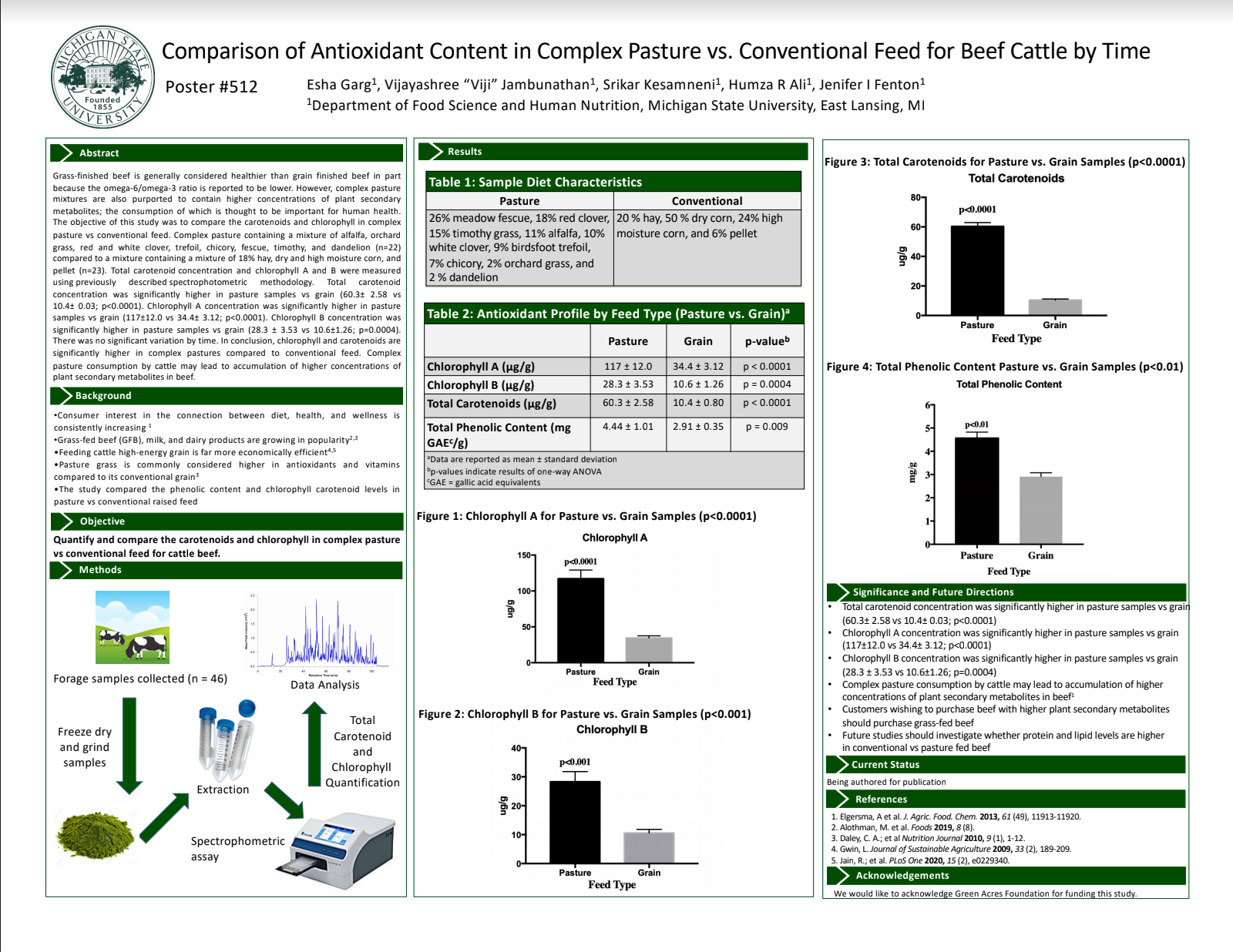
Grass-finished beef is generally considered healthier than grain finished beef in part because the omega-6/omega-3 ratio is reported to be lower. However, complex pasture mixtures are also purported to contain higher concentrations of plant secondary metabolites; the consumption of which is thought to be important for human health. The objective of this study was to compare the carotenoids and chlorophyll in complex pasture vs conventional feed.
Complex pasture containing a mixture of alfalfa, orchard grass, red and white clover, trefoil, chicory, fescue, timothy, and dandelion (n=22) compared to a mixture containing a mixture of 18% hay, dry and high moisture corn, and pellet (n=23). Total carotenoid concentration, chlorophyll A and B, \ were measured using previously described spectrophotometric methodology. Total carotenoid concentration was significantly higher in pasture samples vs grain (60.3± 2.58 vs 10.4± 0.03; p<0.0001). Chlorophyll A concentration was significantly higher in pasture samples vs grain (117±12.0 vs 34.4± 3.12; p<0.0001). Chlorophyll B concentration was significantly higher in pasture samples vs grain (28.3 ± 3.53 vs 10.6±1.26; p=0.0004). There was no significant variation by time. In conclusion, chlorophyll and carotenoids are significantly higher in complex pastures compared to conventional feed. Complex pasture consumption by cattle may lead to accumulation of higher concentrations of plant secondary metabolites in beef.
Click to open in new tab.